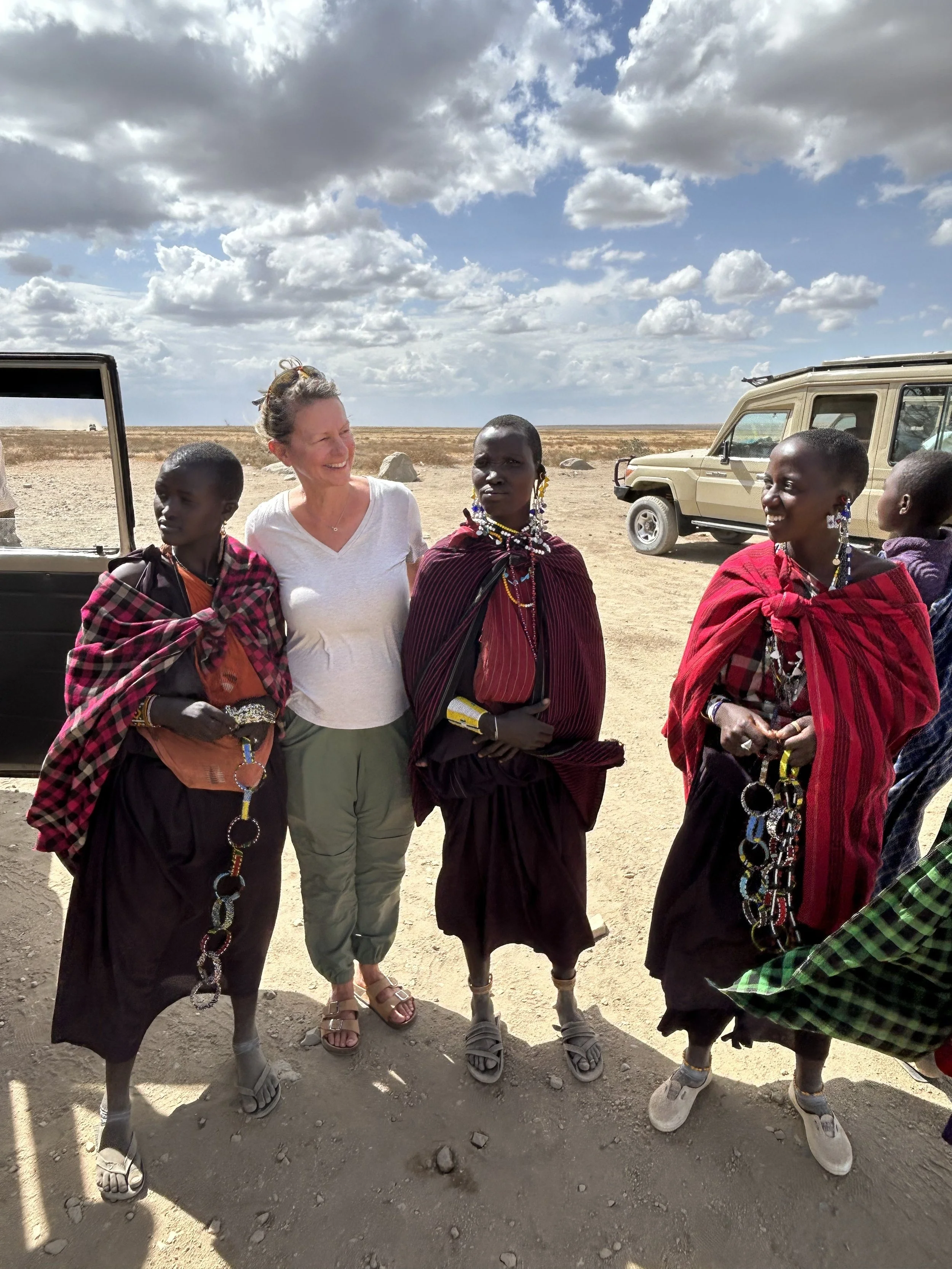
Travelling to another country is an opportunity to hold up a mirror and see who is looking back. And as I discovered recently on a trip in East Africa, you might not like what you see.
My husband Tom and I were on a bus from Nairobi, Kenya, to Arusha, Tanzania, when we had to unload and walk through border control. It was a lengthy process of standing in one line, and then another, and then another, before papers were verified, fingerprints collected, photos taken, and passports stamped. By the time we exited the building to get back on the bus nearly three hours later, we were hot, thirsty, and a tad grumpy.
And that’s when we were swarmed by a group of Maasai women. We didn’t know much about the Maasai at this point in our journey, other than that many lived in small villages, wore brightly coloured shukas, and made money from selling jewelry and other trinkets to tourists.
It turned out these Maasai women were also exceptional saleswomen, in that they were very assertive and did not take no for an answer. Surrounded by a sea of bright red, yellow, orange, and pink shukas, these women pushed their homemade bracelets, necklaces, beaded safari animals, and other trinkets in our faces as we desperately tried to make our way to the bus. “You buy,” they would say. “You support, buy from me, buy my bracelet.”
Tom and I were caught off guard and thoroughly unprepared to handle this onslaught. In our discomfort, we kept repeating, “I have no money, sorry,” as we continued moving towards our bus. They followed and kept putting items in our faces, even trying to get a bracelet or two around my wrist.
Eventually, we managed to slip into the hot, stuffy bus, where we thought we would find sanctuary. We were wrong. A few women stood at the open door, and others walked around to our window, pushing their jewelry through the opening towards me. I kept saying, “No thank you, I don’t have any money,” but they wouldn’t leave. I was increasingly uncomfortable and irritated by these insistent women. Why couldn’t they take no for an answer? Why couldn’t they go find someone else to harass? Did I have “sucker” written on my forehead or something? Was that why they were targeting me? So I resorted to closing the window and drawing the curtain to block them out.
And in my head, I was silently praying the driver would get on the bus and take us away from this little personal hell. And yes, I was that uncomfortable with the whole thing.
Eventually, everyone who was supposed to be on the bus was in their seat. As the driver pulled out, I took a deep sigh of relief, pulled the curtain back, opened the window, and felt comforted by the cool air and that sense of getting away.
For the rest of the journey, though, and well into that night, something else was stirring within me. Discontentment. Discontentment and disappointment with myself and who I was choosing to be when I was with the Maasai. The mirror was up, and the woman looking back at me wasn’t the woman I imagined myself being.
I want to be someone who raises others up, who helps others feel seen and heard. That’s the work I do, so I thought I was that woman. And yet, the moment I felt uncomfortable, I pulled back, put up a barrier, and physically, mentally, and emotionally blocked these other women out.
To be clear, I never once felt threatened. I was just uncomfortable and irritated with these women and their persistence.
That night, lying in bed, I replayed the scene and felt ashamed of my behaviour. But I also saw the opportunity to grow from it. What was really going on for me here, I pondered. As I explored my feelings, I realized there was a subconscious story I was playing in my head that I wasn’t fully aware of at the time. It went something like this: “They want my money. They’re going to rip me off. They’re going to take advantage of my ignorance. I don’t want to be the ignorant fool who gets played.”
Identifying the story helped me release it. It’s just a story, I told myself, fuelled by my fears. And here’s another story, perhaps one that is more accurate. It’s about a group of women trying to make a living by selling the beautiful jewelry they made to support their village. That story made more sense and aligned with what I was actually seeing and understood about the Maasai.
So that night I made a promise to myself to do better and to show up as the woman I want to be—kind, generous, and open.
The next morning, I shared my thoughts about the experience and my personal reflections with Tom and discovered he felt the same. We agreed we would both do better. Fortunately, we had ample opportunity to practise this intention.
Our next encounter was better, just not great. We thought buying some jewelry would improve the experience and make it more enjoyable. While I found a few things I liked, the experience just felt transactional. I didn’t like that either.
But with each new encounter, things did get better. I think, in large measure, they got better because I was relaxing more into myself and leading with kindness, curiosity, and greater openness.
My favourite encounter was the day we left Tanzania and found ourselves at the border crossing once again, this time heading back into Kenya. It was another three hours of trying to get a busload of people approved for entry, and Tom and I were among the first out of the building. As a result, we had lots of time with the Maasai before everyone was cleared, and this time we fully embraced the experience and allowed ourselves to just be with them.
I had a little bit of Tanzanian shillings left, which I promptly spent on more bracelets (I had purchased many on this trip in my quest to “do better”). After spending all the money I had, these women still gathered around me, all eagerly showing me their creations while trying to put items in my hands. This time, instead of getting flustered and walking away, I got conversational. “Did you make this?” I’d ask, looking closely at a necklace that was now in my hands. “This is beautiful,” I’d say, and hand it back. “Did you make all of this jewelry?” “Yes,” was the proud reply. I took my time looking at and appreciating the beautiful things they had created.
Eventually, I climbed back onto the bus, and of course, the women came around to my window. I opened it wide and leaned out, smiling. An older lady with bright eyes, a big smile, and surprisingly white teeth showed me her bracelets. I put my arms out the window to show her all of mine. She looked thoughtfully at them, then selected one from her collection and, with a sparkle in her eye, said, “This one, you buy.” Clearly, she thought I was missing an important piece. I couldn’t help but laugh. She laughed too. I asked her name. “Angus,” she said. And somehow, that surprised me. Maybe she saw the surprise on my face, because she laughed again.
Then another woman with a baby on her back moved towards us. I had a banana in my bag, so I pulled it out and handed it to her, saying, “For the baby.” She took it with a smile, and a moment later, she was sitting under a tree, mashing the banana with her fingers and feeding it to her baby. She looked up at me and waved. “Thank you,” that wave seemed to say, and in that moment, I saw another mother, like any mother, looking out for her child.
Then Angus was back, showing me more bracelets, necklaces, and other trinkets she had made. They were all beautiful, and I enjoyed looking at them and oohing and ahhing. I kept telling her I had no more money to buy anything else. I knew she understood, but maybe she didn’t believe me, or maybe she was just having some fun with me. She then said, “I take your credit card,” and we both laughed.
The truth is, the whole experience was incredibly delightful. When I changed my own inner story, I started to see the Maasai through a different lens. The encounters became much richer and more meaningful.
So I’m grateful for that uncomfortable experience the first time I encountered the Maasai. It gave me the opportunity to look in that mirror, challenge my stories, and choose to do better. I hope I always have the courage to look in that mirror. It’s not easy when you see something you don’t like. But if you’re willing to face what you see with love and compassion, you give yourself the opportunity to choose differently—to act in ways that are more aligned with who you want to be.
I truly enjoyed my encounters with the Maasai, particularly that last day at a hot border crossing, even if I now have more bracelets than I could ever possibly need.