I thought I had slain this one already?
On the second last day of walking the Camino last month, an article was shared with me by one of my sister walkers. The article invited us to reflect on several questions. One spoke loudly to me:
“How did I meet what the Camino placed in front of me?”
Well, it placed my own demon in front of me, I thought dryly.
The demon of not-enoughness.
The next day we arrived in Santiago, and that evening my demon had brought me to tears.
I would be lying if I said I didn’t try to deny and push away my feelings. As a coach, I know that’s not the most helpful thing to do. And yet there I was, resisting with all my might the inner disturbance that wanted to burst out of me.
I would also be lying if I said I didn’t beat myself up a wee bit for feeling so disturbed.
“I can’t believe I’m still dealing with this same old demon. I thought I had slain this one already.”
Maybe you've had similar experiences.
You think you've done the work. You've had the insights. You've healed the wound. And then, out of nowhere, something happens and there it is again.
The old insecurity, that darn old fear, that old story you just can’t seem to shake!
We often think healing should be linear and that once we've learned the lesson, we'll never have to face it again.
I’ve discovered that’s seldom the case.
What I’ve come to understand is that healing isn't about never being triggered again. It's about meeting the trigger differently each time it appears.
Interestingly—or perhaps more accurately, divinely guided—with me I had a copy of Michael Singer's newest book, Wisdom Untethered. I didn't open it much during this group walk, but on this particular evening, as I crawled into bed feeling emotionally drained from all the competing feelings—from exhilaration to exhaustion, from joy to sadness, from delight to overwhelm—I opened the book and began reading the next chapter.
It was about surrender.
In this chapter, Singer explains how emotional triggers can be great gifts because they show us precisely what still wants to be released so we can return to the essence of who we truly are.
He writes that the way through these emotions is not to push them away, deny them, or shame ourselves for having them. It's to allow them to rise up and move through us.
Not with stories like, "I thought I dealt with you already.” Or with judgments like, "What is wrong with me that I feel this way again?"
Have you ever said anything like that to yourself?
If so, read on.
Singer uses an analogy of standing in a storm. When we resist our emotional disturbances, it's as though we're trying to hold up a wall against the wind. The storm keeps pushing against us and eventually we become exhausted from the effort of holding up that wall.
He says if we stop fighting and simply stand there, the wind blows around us and past us.
This is surrender. And each time we do it, the storm loses a little of its power.
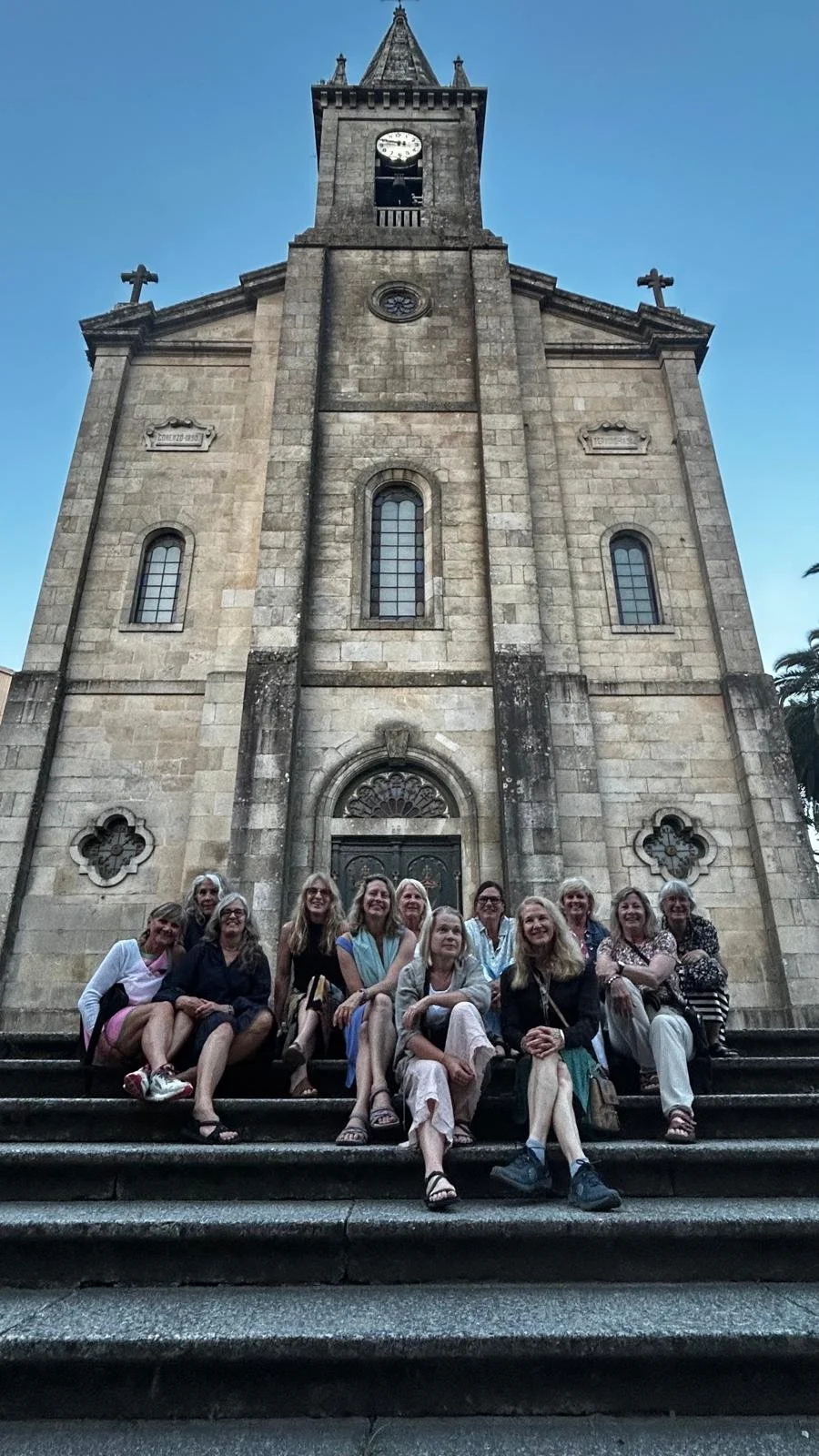
What the Camino placed in front of me this year were women in my group who possessed attributes I've often thought I lacked.
Women who are fiercely intelligent, incredibly funny, and effortlessly stylish.
Three things I've long judged myself for not having enough of.
Not smart enough.
Not funny enough.
And definitely not stylish enough.
(And lately I've been feeling borderline frumpy.)
These women stirred a storm within me. The feeling was fleeting because I've been doing the inner work for years. But it was there all the same.
And in seeing it, recognizing it, and then reading Singer's words that evening, I realized something new.
Maybe this isn't a demon that needs to be slain. Maybe it’s a part of me asking to be loved.
Maybe it's the younger part of me that learned somewhere along the way that she was less than, and each time she appears, she isn't showing up because I've failed to heal, she’s showing up because she's asking to be met with compassion.
The Camino didn't show me a flaw I still need to fix. It showed me a place where I can still soften. And perhaps that is what healing really looks like.
Not becoming someone who is never disturbed. But becoming someone who knows how to meet those disturbances with greater awareness, greater compassion, and a little more love each time they arise.
Now here’s a question for you:
Is there a part of yourself you've been trying to slay that might actually be asking to be loved?
Perhaps the next time your emotions get stirred, instead of asking, "What's wrong with me?" you might ask, "What is asking to be loved here?"